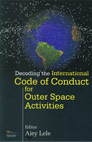
Space technologies are critical to diverse human activities including communication, education, navigation, and remote sensing, meteorology disaster management and military. Naturally, keeping the space assets secure has become a major necessity for the states. Any damage to such assets would lead to excruciating consequences. In order to ensure safety and security of these assets it is important to establish a mechanism for international cooperation relating to the activities in exploration and use of outer space. For this purpose the European Union (EU) had floated an idea of a code of conduct for activities in outer space in 2008. Over the last four years some discussions and deliberations on the draft circulated by the EU had taken place and certain modifications in their proposals have been carried out and accordingly the draft has been modified.
Appreciating the universality of this subject the EU has put forth this draft as an International Code of Conduct for Outer Space Activities for multilateral negotiations. This book debates a range of issues in regard to this code and presents a diversity of views from experts representing various parts of the world. These discussions involve largely the geopolitical, technological and legal interpretations of this draft.
http://www.idsa.in/system/files/book_OuterSpaceActivities.pdf


 The purpose of the Second Review Conference in 2012 is to review
progress made in the implementation of the Programme of Action to
Prevent, Combat and Eradicate the Illicit Trade in Small Arms and
Light Weapons in All Its Aspects (PoA) and the International Tracing
Instrument. This report seeks to quantify efforts to implement the
national level commitments contained in the PoA and the International
Tracing Instrument, in order to identify areas where implementation
has been strong and where examples of best practice may be available,
as well as to identify gaps in implementation and areas where implementation
efforts have been weak or have faced difficulties. The analysis
was conducted on a regional and subregional basis to identify trends
and patterns with respect to implementation efforts at these levels.
The purpose of the Second Review Conference in 2012 is to review
progress made in the implementation of the Programme of Action to
Prevent, Combat and Eradicate the Illicit Trade in Small Arms and
Light Weapons in All Its Aspects (PoA) and the International Tracing
Instrument. This report seeks to quantify efforts to implement the
national level commitments contained in the PoA and the International
Tracing Instrument, in order to identify areas where implementation
has been strong and where examples of best practice may be available,
as well as to identify gaps in implementation and areas where implementation
efforts have been weak or have faced difficulties. The analysis
was conducted on a regional and subregional basis to identify trends
and patterns with respect to implementation efforts at these levels.

 A Call for Change: Higher Defence Management in India | Institute for Defence Studies and Analyses